By JIM BAWDEN
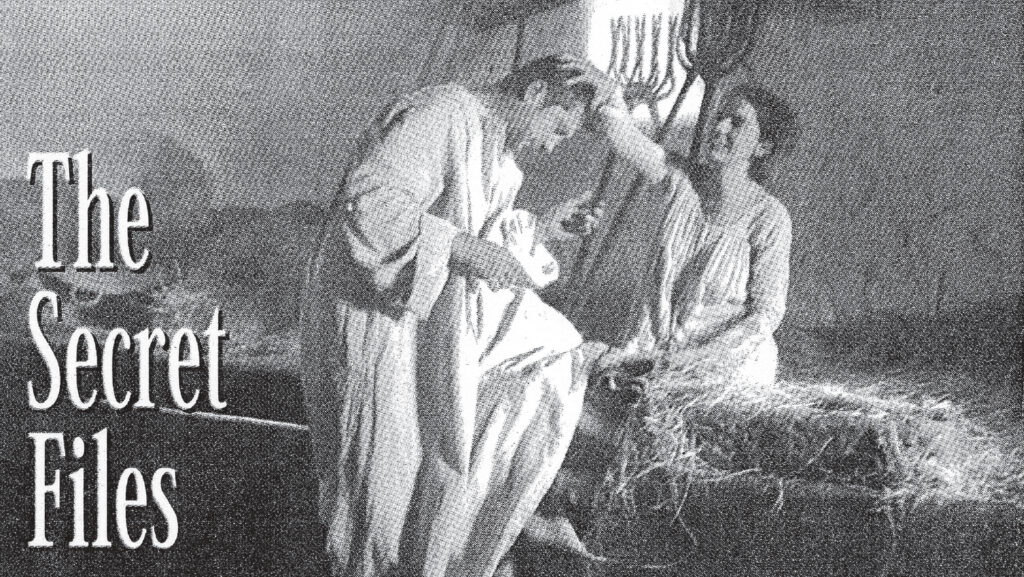
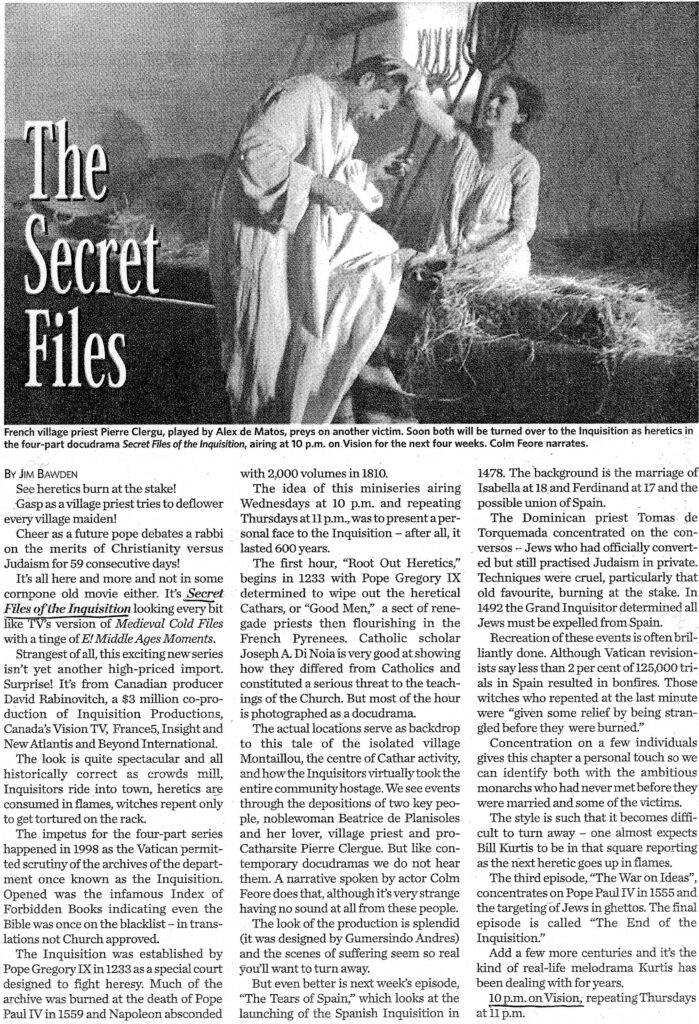
French village priest Pierre Clergu, played by Alex de Matos, preys on another victim. Soon both will be turned over to the Inquisition as heretics in the four-part docudrama Secret Files of the Inquisition, airing at 10 p.m. on Vision for the next four weeks. Colm Feore narrates.
See heretics burn at the stake!
Gasp as a village priest tries to deflower every village maiden!
Cheer as a future pope debates a rabbi on the merits of Christianity versus Judaism for 59 consecutive days!
It’s all here and more and not in some cornpone old movie either. It’s Secret Files of the Inquisition looking every bit like TV’s version of Medieval Cold Files with a tinge of E! Middle Ages Moments.
Strangest of all, this exciting new series isn’t yet another high-priced import. Surprise! It’s from Canadian producer David Rabinovitch, a $3 million co-production of Inquisition Productions, Canada’s VisionTV, France5, Insight and New Atlantis and Beyond International.
The look is quite spectacular and all historically correct as crowds mill, inquisitors ride into town, heretics are consumed in flames, witches repent only to get tortured on the rack.
The impetus for the four-part series happened in 1998 as the Vatican permitted scrutiny of the archives of the department once known as the Inquisition. Opened was the infamous Index of Forbidden Books indicating even the Bible was once on the blacklist — in translations not Church approved.
The Inquisition was established by Pope Gregory IX in 1233 as a special court designed to fight heresy. Much of the archive was burned at the death of Pope Paul IV in 1559 and Napoleon absconded with 2,000 volumes in 1810.
The idea of this miniseries airing Wednesdays at 10 p.m. and repeating Thursdays at 11 p.m. was to present a personal face to the Inquisition — after all, it lasted 600 years.
The first hour, “Root Out Heretics,” begins in 1233 with Pope Gregory IX determined to wipe out the heretical Cathars, or “Good Men,” a sect of renegade priests then flourishing in the French Pyrenees. Catholic scholar Joseph A. Di Noia is very good at showing how they differed from Catholics and constituted a serious threat to the teachings of the Church. But most of the hour is photographed as a docudrama.
The actual locations serve as backdrop to this tale of the isolated village Montaillou, the centre of Cathar activity, and how the Inquisitors virtually took the entire community hostage. We see events through the depositions of two key people, noblewoman Beatrice de Planissoles and her lover, village priest and pro-Catharite Pierre Clergue. But like contemporary docudramas we do not hear them. A narrative spoken by actor Colm Feore does that, although it’s very strange having no sound at all from these people.
The look of the production is splendid (it was designed by Gumensindo Andres) and the scenes of suffering seem so real you’ll want to turn away.
But even better is next week’s episode, “The Tears of Spain,” which looks at the launching of the Spanish Inquisition in 1478. The background is the marriage of Isabella at 18 and Ferdinand at 17 and the possible union of Spain.
The Dominican priest Tomas de Torquemada concentrated on the conversos — Jews who had officially converted but still practised Judaism in private. Techniques were cruel, particularly that old favourite, burning at the stake. In 1492 the Grand Inquisitor determined all Jews must be expelled from Spain.
Recreation of these events is often brilliantly done. Although Vatican revisionists say less than 2 per cent of 125,000 trials in Spain resulted in bonfires. Those witches who repented at the last minute were “given some relief by being strangled before they were burned.”
Concentration on a few individuals gives this chapter a personal touch so we can identify both with the ambitious monarchs who had never met before they were married and some of the victims.
The style is such that it becomes difficult to turn away — one almost expects Bill Kurtis to be in that square reporting as the next heretic goes up in flames.
The third episode, “The War on Ideas,” concentrates on Pope Paul IV in 1555 and the targeting of Jews in ghettos. The final episode is called “The End of the Inquisition.”
Add a few more centuries and it’s the kind of real-life melodrama Kurtis has been dealing with for years.