June 2007
By Tim Metzger
My zoom lens frames tightly on the face of a frightened boy, crying out to his mother and father for help.
Intuitively I tilt down and slowly widen my frame to reveal a carabinieri’s rifle stock forcefully planted against the father’s chest. As the father attempts to reach his tearful son’s hand, I pan over, framing on the pleading and crying mother. The boy is being kidnapped by the Inquisition, on the orders of the Pope.
I hear the director call “cut,” but I keep rolling on a close-up of the police officer’s face—hardened and full of self-contempt.
I’m on location in Spain, shooting in high definition for the miniseries Secret Files of the Inquisition. This docudrama reveals true and untold stories about the Roman Catholic Church’s centuries-long crusade against heretics, based on transcripts that have been locked away in the church’s archives for as many as 600 years. Pope John Paul II granted access to these files in 1999 to create a millennium cleansing for the church. Now, an international crew has gathered to bring these stories to life. Broadcast to critical acclaim in Canada, the UK, Australia, and France, the series will have its American premiere on PBS in May.
Docudramas bring cinéma vérité or documentary-style shooting together with the dramatic filming style of a feature film. At first glance, these two styles appear to be totally at odds with one another. One captures people as they experience a real moment in an authentic location, with little direction and often unanticipated movement and interactions. The other requires control over lighting, acting, direction, location, and props. To bring these seemingly antithetical approaches together, the director, David Rabinovitch, would rehearse and build the scenes with the cast, while the A camera unit was lighting the set. I would often shoot these improvisations, and many of these moments found their way into the final films.
I served as one of Inquisition’s two cinematographers. I live near San Francisco, and have spent my professional life shooting documentaries for television. The other cinematographer, Pieter Stathis, is a Canadian living in Vancouver with a background in shooting dramatic feature films. We met in Spain and spent almost 8 weeks together shooting Inquisition’s four hour-long episodes.
Starting out
How did we approach the shoot? We started with two Sony F900 HD cameras. Pieter used the Canon HJ11x4.7B HD wide-angle cine zoom lens, while I used the Canon HJ22ex7.6B HD telephoto zoom lens. Before we began shooting, we had our engineer, Rafa Roche, match the color differences of the two cameras and lenses. Sony’s Madrid branch shaded our lenses and made lens files for both cameras.
Because of our docudrama style, we could not take much time to tweak the cameras between setups—but the cameras had to match constantly. Since each episode reflected a different time in history, each required a different cinematic look. We knew we would have to shoot the episodes out of sequence—and we knew we would not have Rafa or another engineer with us on the shoot.
To solve these problems, we used the removable Memory Stick media in the F900 cameras to store all the information we needed in order to match the two cameras quickly. The Memory Sticks also stored all of the various historical looks that we had created before the shooting began. We kept cameras on preset, never used the white balance, and left the detail off.
We rolled in the appropriate built-in camera filters as we needed them: 5600K, 6400K, 4300K, and 3200K, along with the various ND filters and predetermined 5 x 5.6 colored filters for each of the episodes. Before shooting a specific scene for a particular episode, the assistant cameramen (Raul Cardenas and Peter Carty) would recall the appropriate scene and setup information from the camera’s Memory Stick and load the information into our cameras. At the same time they would add or subtract from the cameras’ matte boxes the appropriate 5 x 5.6 filters that we had chosen. The whole process took less than 5 minutes. (We made final tweaking and color adjustments online.)
Spanning settings
Pieter and David had settled on dramatic looks for each of the four episodes.
Episode 1—which takes place in 13th century France, in the time of the Cathars—has a romantic, pastoral and innocently beautiful look. We used a Tiffen Enhancer filter, which really popped the reds and greens, and made the faces and skin tones rosier. Occasionally we used a polarizer to enhance the blue skies, but we had to dial the polarizers back a bit because an intense sky blue goes a long way in HD. As we would do in Episodes 2 and 3, we also added a Tiffen 1/4 Black Pro-mist filter to create a diffused filmic overtone.
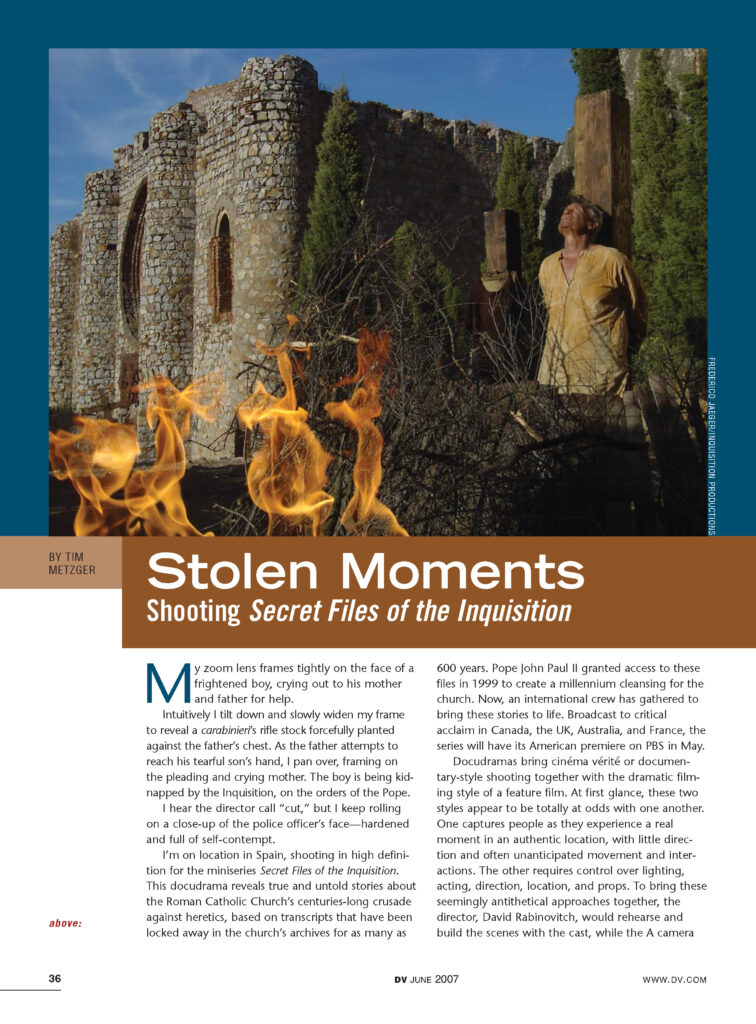
For Episode 2, set in Spain in the mid-15th century, we wanted to create a hot, burnt-out, bleached-out kind of look so the viewers would actually feel the sun on the characters. This tobacco hue made for a predominance of ocher and yellows, enhancing the episode’s fire scenes. However, instead of using a Tobacco 1 filter, which we found to be too heavy looking, we had Rafa create a 1/2 Tobacco look in the actual matrix of the Sony F900 HD cameras. With so many low-lit dungeon scenes (read: lots of candles and torches) in this episode, the actual Tobacco 1 filter caused an exposure loss of two stops. The virtual Tobacco filter built into the matrix of the Sony F900 had no exposure loss at all—a boon for us, because we had found that the extra layer of glass in front of the lenses created a double-reflection problem in our image from all the fire sources on our sets.
Episode 3 takes place in Italy during the 16th century, in the period of the Renaissance. We chose a Tiffen Chocolate 1 filter for the front of the lenses to bring out the richness in the costumes and the architecture, as well as the skin tones. The filter made this episode look a bit more opulent with a contemporary feel.
With the era of technology just around the corner in Episode 4, we went with a cooler, more desaturated, less diffused look—similar to old-style photography that has a slight blue tint to it. We set the F900s on filter wheel C, which is 4500K, when we shot outdoors. In addition, we used a Tiffen 1/8 Black Pro-mist filter instead of 1/4 BP, making the images a bit more crisp compared to the other three episodes.
Hidden cameras
While Pieter was in charge of lighting and shooting the establishing shots or wide shots, my task as the second cinematographer was to capture—with a long telephoto lens that ranged 7.6 mm to 334 mm—the urgency of the action, the close-ups of the character’s faces, and the richness of the costumes and set details.
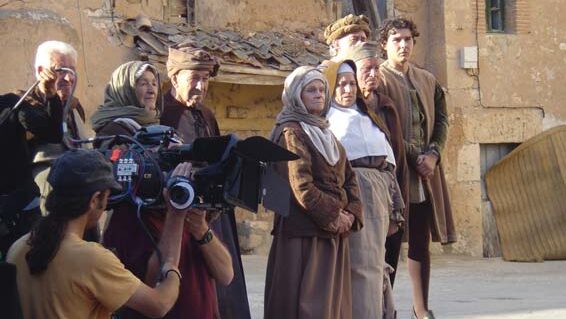
My biggest challenges were to place the viewer right in the middle of the action, and make the events feel like they actually were happening. At least half the story material involved extras or villagers who were not professional actors. We found it very important to keep their actions realistic, and not shoot them trying to act. We gave the cast simple directions and just let them be themselves. I would try to discover and shoot these authentic moments without the extras knowing I was there.
This hidden camera technique works well, because the camera is not in the extras’ faces—which could make them feel self-conscious and uncomfortable. I would see an authentic moment start to happen and grab it before it disappeared or was gone. One of our production managers nicknamed this style of shooting “the filming of stolen moments.” I would shoot these non-actors before a take, during a take, and oftentimes after the director called “cut.”
Ultimately, I wanted to make the audience feel that they were witnessing these tragic events firsthand. Documentary cameramen seek this effect all the time, creating energy in the photography while moving and framing without a rehearsal. To accomplish this you must immerse yourself in the moment, anticipate what will happen next, and shoot it before it fades away. Shoot as if you’re only going to get one take adds an edge of wakefulness to your shots and helps create realism.
I have always admired the work of the late director Robert Altman, who proved these techniques work successfully. His cameras are often moving, and his actors would never know when they were being filmed or which take would be used. This shooting style kept their acting looking fresh, just like in a play. In a similar style, David, Pieter, and I tried very hard to keep the filmmaking process out of the way of the performers on the set.
In medias res
Pieter and I would always shoot simultaneously during the takes. We set the timecode on the cameras to free run and time of day, so the editors could easily match the action and cut between the A and B cameras without worrying about continuity.
Because David and I have worked together for many years, I understood the filmic style he wanted and how to make my shots and Pieter’s shots cut together. Normally the director of photography directs the framing and the movement of the second camera, but in this case, I was free to shoot whatever we needed.
I had a lightweight tripod (a Sachtler 20P) and small lithium-ion batteries, both of which made it easy to reframe or reset quickly. Often I would get a fresh angle or concentrate on someone or something new within the same setup, which enabled us to move through the script more quickly, and afforded the editors with a lot of extra footage to make the sequences more visually exciting.
Without Raul Cardenas, a talented assistant cameraman from Spain, my job would have been impossible. Prior to each shot I would give Raul three to five points of focus in the scene. Raul had to spot those points and be in focus as we came to each one. This isn’t easy with a telephoto lens, and especially in HD, because the depth of field is very narrow (in some cases, it’s only a couple of inches).
In addition, Raul had no idea which point of focus I was going to shoot next. Working within the documentary style, my framing rested only when necessary—I was constantly following the action and discovering new elements of the story. Such fluid activity caused the point of focus to change continually.
To help solve this problem we mounted a small 6-inch HD monitor to one side of the camera. The monitor had peaking, so Raul would know if he missed his mark. The monitor also allowed Raul to see where my framing was going and to match his pre-marked focus points with the subjects in my shot. Thanks to Raul’s work, the audience has a strong sense that Inquisition’s scenes are real, being shot live and in perfect focus.
It’s a wrap
Our director understood the power of docudrama shooting. At the end of each day David would assemble all the department heads at the next location to discuss production needs for the new scenes to be shot. He took the time to listen to everyone’s suggestions, keeping the crew’s collective spirit alive and well.
Before we knew it the next day would be upon us. We finished production in the square of an old Spanish village, in the year 1478. The set alone had taken 4 days to build. The 28-member cast was in make up and the shot list was extensive.
Pieter strapped on the Steadicam and we both started shooting the procession of the accused, led through a town full of soldiers and jeering Catholic accusers. The fires are being kindled and the inquisitor is on the dais, condemning heretic victims to death. Through my lens I see the victims’ hands being tied and the dry branches set on fire at the foot of the three stakes. The inquisitor wipes his brow in the heat, and I see the burning man’s tormented wife and child watch as the flames grow higher.
The actors are stoic, brave, and frightened from all the real fire and heat. Suddenly I hear someone tell the director that the fire department has to leave—that means the fire effects would have to stop. Then one of the main actors leaves the set—it appears something important was lost in the assistant director’s English-Spanish translation for the day’s schedule. However, David keeps sending new characters into the crowd, and Pieter and I keep shooting and listening to the director on our headsets, getting details on the last-minute coverage he needs.
All action ceases when the safety crew extinguishes the fires. The set is full of blinding white smoke. The strategy of shooting scenes in one or two takes has really paid off this time. Out of the corner of my eye I see the director nodding that we have enough shots to make the scene work.
I hear the AD yell, “Cut—that’s a wrap.” Not for me—I’m still rolling on a small fire that’s still smoldering where one of the victims had been staked. I slowly zoom into the remains of a human skull—made of wax—that looks amazingly real in the dramatic waning light of the fire.