
February 2006
By JOHN DOYLE
Not only is the space for seriousness getting smaller, but the space for dissent from orthodoxy is becoming tiny. Yet, on Oprah last week, an entire show was devoted to the question, “What should you be worried about?” and a panel of serious people was interviewed about the threat of terrorism and its meaning. The show included a clip of Senator Hillary Rodham Clinton saying, “Well, right now the greatest threat to world peace is intolerance cloaked in religion. It’s people who believe that their religious views are the only right ones.”
It was a serious, sobering statement and it brings us to a program airing tonight, a rare example of sobriety in a maddeningly trivial-filled week.
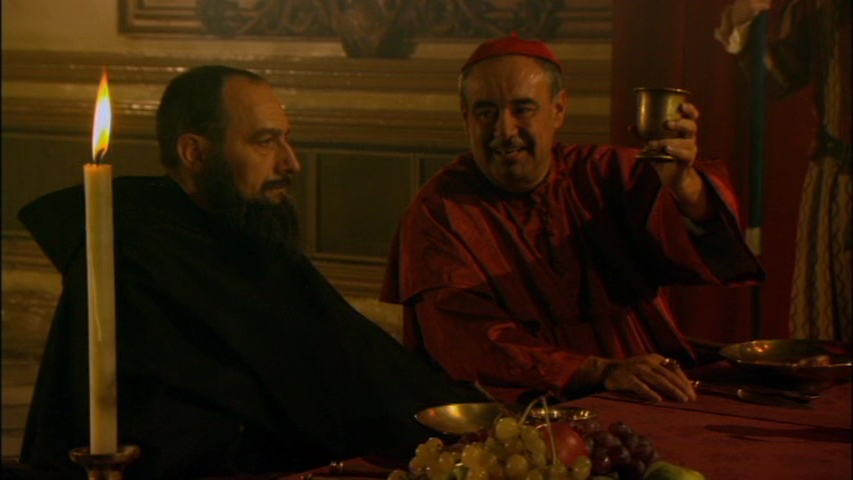
Secret Files of the Inquisition (Vision TV, 10 p.m.) is an extraordinary four-part series. For a start, it’s the most expensive and ambitious one that tiny, noble Vision TV has ever done. It’s a docudrama of sorts and while it is about the distant past, it has a ringing resonance for us today.
Everybody is familiar with the Inquisition in some way, if only from those Monty Python sketches. A few years ago, the Vatican opened a portion of its Inquisition archives to scholars. The archives included transcripts of the interrogation and trial of suspected heretics in France and Spain in the 13th and 14th centuries. They also included vivid descriptions of life in towns and villages where the Inquisition took place.
Producer David Rabinovitch studied the archives, and the series’s many dramatizations include only the direct words from the transcripts. We get an amazingly detailed picture of ordinary people caught up in a fanatical attempt to root out alleged dissension from the official procedures and beliefs of the Catholic Church.
The opening program tonight, set in the 1320s, is about the imprisonment of an entire village and the interrogation of everyone. The villagers’ religious beliefs, finances and sex lives are rigorously scrutinized. At this point in the Inquisition, the main point seemed to be to root out the dissenting Cathars and condemn all who were associated with them.
While some dramatizations are a bit hokey, the series has a profound fascination. Narrated by actor Colm Feore with exquisite attention to irony, it underlines how timeless the core issues are. It’s about orthodoxy and the fury of the powerful when dissent emerges. It is about people trying to be decent under extreme pressure from authority. It is about love and pleasure. It’s about the murderous fury religious belief can sometimes unleash.
In the tiny window of seriousness that’s available to us, we should look at something other than silly celebrations of surface beauty and listen to voices from the past, voices that tell us a lot about the here and now.