
…the Spanish Inquisition, but bringing this horrific episode of history to life for a
docudrama proved something of a trial for executive producer/director David Rabinovitch
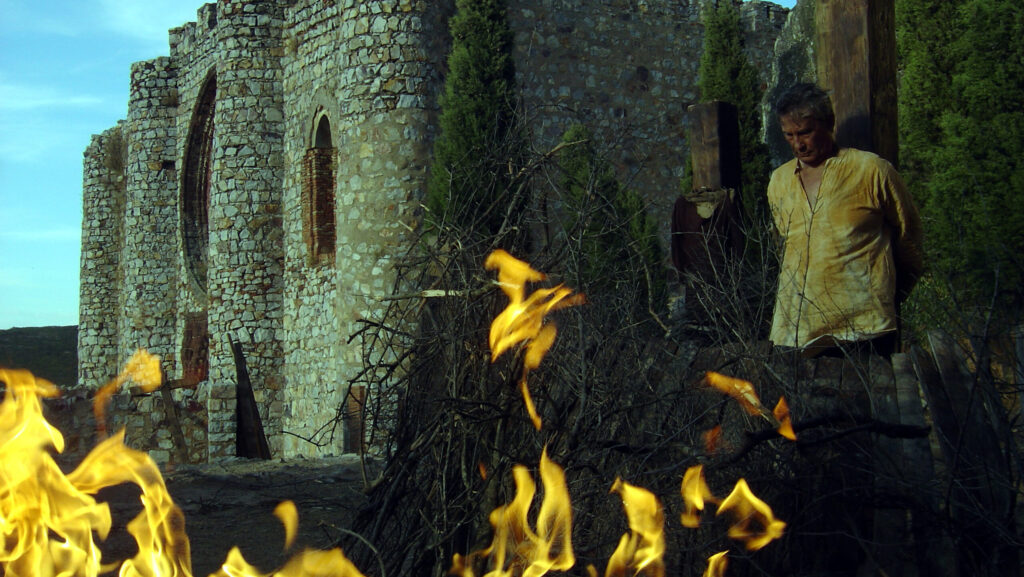
MEN and women are tied to stakes on platforms in the main plaza of a Spanish town. Facing them on a dais, an inquisitor in hooded robes condemns them. As the crowd jeers, guards with torches light the pyres. We have stepped back in time more than 500 years, to 1484 and the awesome terror of the Spanish Inquisition. It is a day of hell, in high definition.
It is 24 September 2004, and after four years of research, we are on location in the remote 14th century Spanish village of Maderuelo shooting scenes for the docudrama mini-series Secret Files of the Inquisition. Based on original archival research, we have set out to recreate the personal stories of some of the victims of the Inquisition, set against the larger backdrop of history.
A Spanish actress is playing one of those victims — a woman named Cinca Cacavi who has been charged with heresy for continuing to observe Jewish customs after she is baptised. She has been tortured to obtain her confession, and now — we are back on the day-of — she is forced to watch her husband being consumed by the flames.
The intensity of the moment is enhanced by the authenticity of the setting. The location where we have built our set for this dark pageant had been the site of similar ceremonies. Everything is true. Of course, no one will be burned here; we are shooting through a cameraman with experience in Canadian feature films. Behind the “B” camera is Tim Metzger, a seasoned documentary cinematographer.
Zaragoza, Spain. Since the Inquisition was a legal procedure, every interrogation was transcribed by notaries. There are said to be more than 85,000 files of the Spanish Inquisition still in existence — some, like Cinca’s, more than 500 years old. I turn the pages of the centuries-old parchment book, scanning the beautiful calligraphy that will reveal Cinca’s haunting, tragic story. When we have her file translated, we will learn every detail of her life, in her own words.
Historical documents like the transcript of Cinca Cacavi provide the original characters for the series. Every word spoken in the characters’ voices comes from their transcripts. As we shoot, I am inspired by the idea that we are honouring the tragic memories of these victims by bringing them to life.
The series has an epic sweep — episode one is set in medieval France, episode two in Spain during the late Middle Ages, episode three in Renaissance Italy, and episode four across all three countries during the 19th century. Locations in Spain will stand in for locations in France and Italy.
“We spend the weekend slashing story to bring the production in line with the rapidly changing economy”
Our search for authentic locations takes us across Spain, from the 1,000-year-old castle of Calatrava, where all of the gear must be hiked up to the pinnacle of a mountain fortress, to Moorish palaces in the south and the 16th century monastery at Uclés, which we rent for a week.
Through years of negotiation, the series has assembled the backing of an international group, including broadcasters from Canada (VisionTV) and France (FR5), an Australian distributor (Beyond), and production partners in Spain (New Atlantis) and Canada (Insight). We were very pleased when UKTV History came on board early on to co-produce the series for the UK.
As the schedule is tight, we take no shortcuts. Tim rarely takes his eye from the viewfinder or his finger off the trigger, capturing many stolen moments that will help enormously when we come to editing.
When the production was $1.20, the falling dollar against the rising euro will result in hundreds of thousands (pick your currency) vanishing like smoke from special effects. After two weeks of shooting we are in danger of shutting down.
On a cool October evening, after an exhausting 12 hours of shooting, I talk by phone to Marty Thompson, our lawyer in Vancouver, trying to get a bank loan approved. We have 36 hours to transfer funds or be shut down. We spend the weekend cutting scenes, slashing strands of story to bring the production in line with the new reality of the rapidly changing global economy.
Finally, Marty comes through. More importantly, so does the bank loan. We pare down the crew — and keep shooting.
After 100 days in Spain, we are shooting the final scene at a decrepit former monastery called Talamanca. The crew is shivering with cold and rats are running through the centuries-old rafters. I have promised the crew that I will play a corpse being dissected. But I have had a terrible flu for a week; it’s too cold and I am too ill. The extras co-ordinator is the only body available — he’ll play the corpse. We get the shot. It’s time to go home. We have survived the Inquisition.
November, 2005. A year later, the programme is edited, scored, mixed and ready for its world premiere on UKTV History.